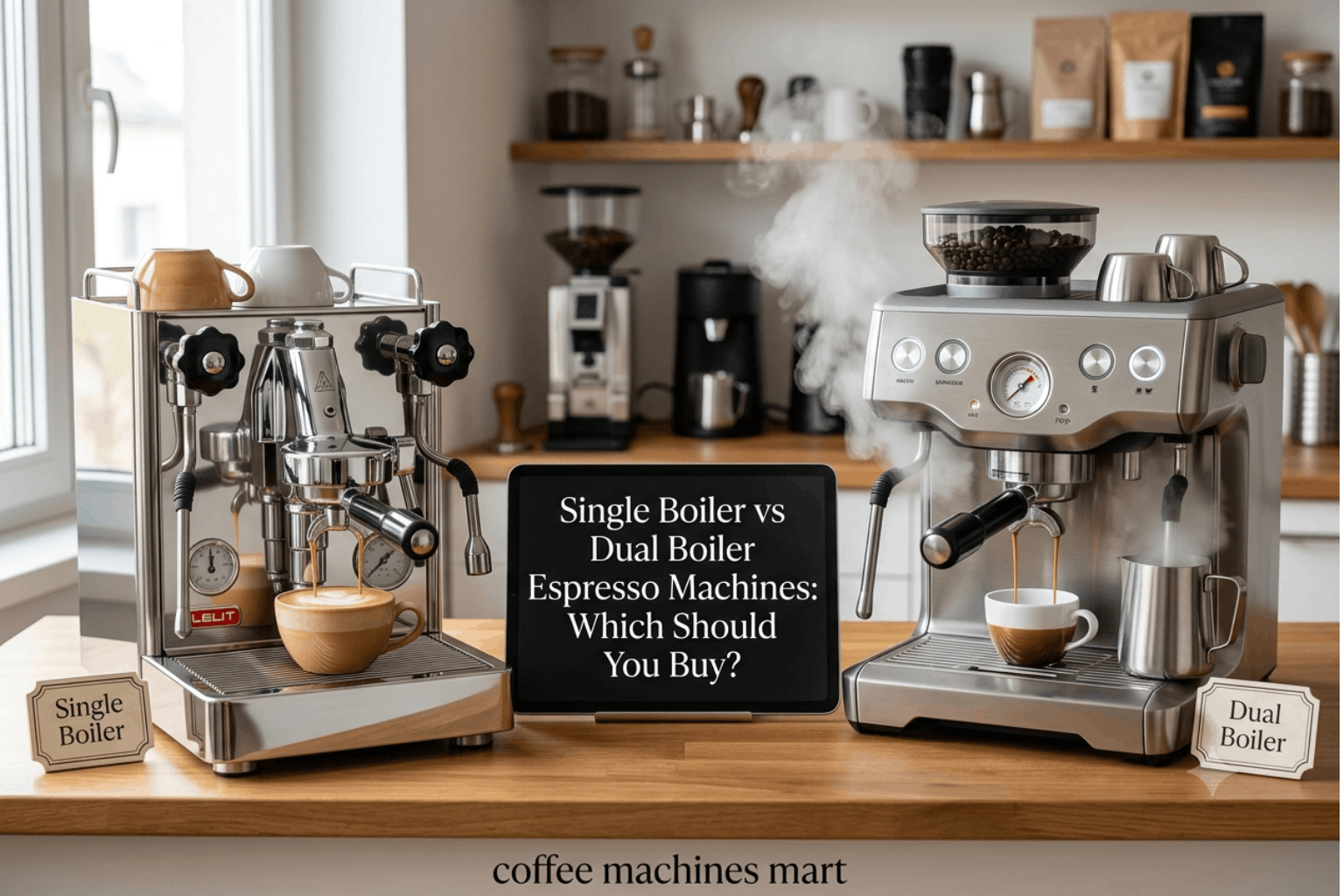
Single Boiler vs Dual Boiler Espresso Machines: Which Should You Buy?

Introduction
Home coffee enthusiasts may find it difficult to make a choice between espresso machines.
This is often the biggest decision and that is the boiler system.
A lot of buyers will ask themselves this question before buying into a single boiler vs. dual boiler espresso machine.
With proper technique both systems can brew a really good espresso.
They are, however, suitable to different brewing methods, price points and lifestyles.
Single boiler machines are simple, compact and inexpensive.
The Dual Boiler machines are more efficient with regard to the steaming performance, temperature control, and workflow.
At Coffee Machines Mart, we assist American coffee lovers pick appropriate coffee machines.
In this guide, you will get to know both systems and make sure that you make a sound decision when purchasing it.
What Is a Single Boiler Espresso Machine?
One boiler espresso machine will have one boiler for steaming and brewing.
The boiler performs both these functions at different temperatures.
Espresso is made at a lower temperature than milk steaming.
This means that you can’t make tea and steam at the same time.
Typically, you’ll start with the espresso shot first.
Afterwards, you activate the machine in steam mode.
The boiler increases its temperature for milk steaming.
Once steamed, you have to wait before preparing another espresso.
Some machines feature PID temperature controls for enhanced brewing stability.
PID control doesn’t eliminate the temperature switching step, however.
Single boiler machines will serve you best if you’re making a single beverage at a time.
They are also good for those who primarily consume straight espressos.
What is a Dual Boiler Espresso Machine?
Dual boiler espresso machine is equipped with two boilers.
An espresso boiler is used to make espresso.
Steam is generated in the second boiler for milk drinks.
Each boiler has a set temperature to which it operates.
This setup can be used to brew and steam at the same time.
You can extract espresso simultaneously with steaming the milk.
Multiple drinkers who brew a variety of beverages on a regular basis will find a dual boiler machine to be the better option.
They can also offer more brewing temperature control.
The majority of the premium models have independent PID temperature controls.
Dual boilers are favored by serious at-home baristas for these features.
Single Boiler vs Dual Boiler: Main Differences
The biggest difference involves workflow and temperature management.
| Feature | Single Boiler | Dual Boiler |
| Boiler System | One boiler | Two boilers |
| Brewing | Yes | Yes |
| Steaming | Yes | Yes |
| Simultaneous Brewing | No | Yes |
| Simultaneous Steaming | No | Yes |
| Temperature Control | Good | Excellent |
| Price | Lower | Higher |
| Footprint | Smaller | Larger |
| Maintenance | Simpler | More complex |
| Best For | Casual users | Serious home baristas |
The last choice should be made based on your daily coffee routine.
Brewing Performance
Both boiler systems can make great espresso.
The quality of your extraction is also determined by your grinder, coffee beans, water, and technique.
A good single boiler will provide rich and balanced espresso.
PID temperature control can help to achieve greater consistency in your brew.
Dual boiler machines are more temperature independent.
The brew boiler does not focus on any other brew type, only espresso.
The steam boiler is used to keep the temperature in milk steaming higher.
This separation will make use of the workflow during the busy brewing session.
But having a dual boiler doesn’t necessarily mean getting better espresso.
It is possible to get excellent results from one boiler if the person is skilled in the art of barista.
Temperature Stability
Temperature stability is a crucial factor for espresso extraction.
Even minor variations in temperature will impact flavor and extraction.
Single boiler machines are able to keep the brewing temperature stable.
More control when making espresso with models equipped with PIDs.
But temperature changes are still required for steaming the machine.
Dual boiler machines have two different temperatures for brewing and steaming.
The brew boiler is responsible for keeping the desired espresso temperature.
The steam boiler has a higher steaming temperature maintained.
This configuration offers more flexibility with advanced brewing methods.
It is also advantageous for customers who try out various roasts of their coffee beans.
Single Boiler vs Dual Boiler for Milk Drinks:
The most distinguishing difference between both systems is the milk drinks.
Single boiler machines will need temperature switching.
It’s important to make your espresso first before steaming milk.
However, the machine can then increase the temperature of the boiler.
This adds time delays between drinks.
This is where dual boiler machines come in handy.
Espresso and steamed milk can be made at the same time.
This functionality enables the user to make multiple drinks quicker.
Dual boilers are ideal for:
- Lattes
- Cappuccinos
- Flat whites
- Cortados
- Macchiatos
A dual boiler is a good option if your family consumes multiple milk products.
Single Boiler vs Dual Boiler for Straight Espresso
Two boilers might not be necessary for straight espresso coffee drinkers.
A good quality boiler will give great performance in one brewing.
You can focus your budget on the grinder and coffee beans.
With this method, some great results can be achieved without too much fuss.
Single boilers also take up less counter space.
They typically have lower initial costs.
If you don’t drink milk drinks very often, select one boiler.
If you want more flexibility in use, you will want to use a dual boiler.
Single Boiler vs Dual Boiler for Beginners.
Simple equipment makes for good beginners.
Most single boiler machines will have simple controls.
They have simple controls to help students learn.
Dual boiler machines can also be used by beginners, however.
They offer more flexibility in the workflow at the outset.
They also provide some scope for further experimentation in brewing.
Your thinking should be based on your long-term expectations.
If you prefer a simpler solution, select a single boiler.
For more advanced control, select a dual boiler.
Heat Exchanger vs Single Boiler vs Dual Boiler.
Another popular choice are the heat exchanger machines.
They use one steam boiler with its own path for brewing water.
Concurrently brewing and steaming is possible with this design.
Heat exchanger machines can give good steam performance.
Some of them can also be cheaper than certain dual boiler systems.
But, there is more experience needed for temperature management.
Dual boiler machines offer better temperature control.
Single boilers have the simplest design overall.
The optimum architecture should be based on your brewing techniques.
Pros and Cons of Single Boiler Machines
Pros
Lower Price
Single boiler machines will typically be less expensive than dual boiler machines.
They are a great value for any home barista on a budget.
Compact Design
Some single boiler machines can be used in smaller kitchens.
They are good for a limited number of counter tops and apartments.
Simple Operation
The simple procedure is still straightforward to follow.
Lower Maintenance Complexity
The single boiler-type system has fewer major heating elements.
Excellent Espresso
If you use the right technique, you can make great espresso using a quality model.
Cons
Simultaneous Brewing and Steaming is not permitted.
It’s impossible to make espresso during steaming time.
Temperature Switching
The boiler has to wait in between the two phases of brewing and steaming.
The Milk Drink Workflow was made slower.
There is extra waiting for several milk drinks.
Dual Boiler Machines Pros and Cons.
Pros
Brewing and Steaming at the same time.
It is possible to make espresso and scald milk at the same time.
Better Temperature Control
Independent temperature control with separate boilers.
Powerful Steam
The steam boiler is exclusive and offers good steaming of milk.
Faster Workflow
Multiple drinks need less time to take the steps between drinks.
Advanced Brewing
Some models come equipped with PID controls and more brewing features.
Cons
Higher Price
In most cases, the dual boiler machines will be more expensive.
Larger Footprint
They have extra boilers which demand extra interior room.
Higher Energy Use
There are two types of heating systems that can use more electricity.
More Complex Maintenance
Other components may require more servicing.
Which Machine Uses More Energy?
Single boiler machines typically have less complex heating systems.
Their performance could be lower in the regular espresso brewing.
Dual boiler type machines are those that heat two boilers.
This can add energy usage to this design.
But when it comes to usage, insulation and heating technology can have an impact.
How many brews you have also impacts energy use.
It’s not enough to just look at the energy use when choosing a machine.
Consider performance alongside your usual brewing needs.
Maintenance Differences
All espresso machines need regular maintenance.
Single boiler steamers may be easier to maintain.
Machines that have a dual boiler system have extra parts.
These may need more frequent attention as time goes on.
You should regularly:
- Apply group head cleaner.
- Backflush the machine
- Empty the steam cleaner wand.
- Clean the portafilter
- Replace water filters
- Monitor water quality
Use of filtered water can help minimize mineral deposits.
Follow maintenance requirements from manufacturer
Looking for a PID Espresso Machine?
The stable brewing temperature is achieved with PID technology.
It can help to maintain consistency in espresso extraction.
A PID system is beneficial to both single and dual boiler machines.
Good brewing techniques are, however, no substitute for PID technology.
Grinder and coffee beans are still very important.
If you like to try various roasts, try a PID model.
For advanced users, a fine control over the temperature adjustment is often a desired feature.
How Much Should You Spend?
The grinder is a part of your overall budget.
Using a good grinder can greatly enhance espresso consistency.
Allocate some funds for necessary accoutrements.
These may include:
- Espresso scale
- Tamper
- Milk pitcher
- Water filter
- Cleaning products
Don’t purchase a complete espresso machine package.
A balance setup generally will produce a better overall result.
Who Should Buy a Single Boiler?
If you can only afford a single boiler, then:
- You are a main consumer of espressos.
- Each drink is made individually.
- Milk is rarely treated with steam.
- Small counter space.
- You would prefer to have a cheaper price.
- You like simple equipment.
One boiler will deliver great home brewing results.
It is also quite an affordable option for novices.
Who Should Buy a Dual Boiler?
If you:If you’re a dual boiler user, the following scenarios are for you:
- You make a number of milk cocktails.
- A simultaneous brewing and steaming is required.
- You seem to have many guests over.
- Advanced temperature control is desired.
- You like to tinker with espresso concoctions.
- A long-term prosumer configuration is desired.
For those “big time home baristas,” dual boilers offer more flexibility.
Common Buying Mistakes
Ignoring the Grinder
An espresso grinder with poor grinding performance may influence the quality of espresso coffee.
Make sure to always add up a competent grinder.
Choosing Only by Boiler Size
A larger boiler does not automatically produce better espresso.
Consider the complete machine design instead.
Buying Too Much Machine
Casual coffee drinkers may not be using more advanced features.
Select the features that you really need.
Ignoring Counter Space
When purchasing, take measurements of available countertops.
Don’t forget to leave room for your grinder!
Forgetting Water Quality
It’s possible for hard water to cause scale in the espresso machines.
Always avoid using unfiltered water, if recommended by manufacturer.
Single Boiler vs Dual Boiler: Quick Buying Guide
| Your Priority | Best Choice |
| Lower price | Single Boiler |
| Compact kitchen | Single Boiler |
| Mostly espresso | Single Boiler |
| Simple workflow | Single Boiler |
| Frequent milk drinks | Dual Boiler |
| Simultaneous brewing | Dual Boiler |
| Advanced temperature control | Dual Boiler |
| Multiple daily drinks | Dual Boiler |
| Serious home barista | Dual Boiler |
Frequently Asked Questions
Which is better, a single or dual boiler?
Both systems are not as effective for all users.
Single boilers are designed with simplicity and cost-effectiveness in mind.
Dual boilers are focused on flow and temperature.
Is espresso made with a single boiler machine good?
Yes.
Genuine espressos can come out of the best single boiler.
The results are better with fresh beans and if one has a good grinder.
Are dual boiler machines able to brew and steam at the same time?
Yes.
When there are separate boilers, both can be used concurrently.
Is PID important for espresso?
Yes.
PID technology helps to maintain a stable temperature when brewing.
It can help to create more uniform espressos.
Which boiler system is best for the Latte Lovers?
Dual boilers tend to be more appropriate for people who drink a lot of coffee that requires a hot water extract.
They can be used for simultaneous brewing and steaming of milk.
Is dual boiler necessary at home?
Not necessarily.
If you’re often making milk drinks, select one of these.
Otherwise, one boiler can be a great value.
Final Verdict
You’ll have to make the choice between a single boiler or dual boiler, and that will depend on your coffee habits.
Single boiler machines are simple, compact and inexpensive.
They’re particularly suitable for the home espresso connoisseur.
Dual boiler machines provide better workflow and temperature independence.
They are ideal for milk drinkers who make multiple occasions to drink milk daily.
Both systems aren’t a guarantee of better espressos in themselves.
The grinder, the beans, the water and the technique are still as vital.
At Coffee Machines Mart, it is advisable to select the model that suits your actual coffee brewing needs.
Opt for one boiler system for an easy and low-cost home espresso.
For higher control and more milk drinking, consider a dual boiler.
The best coffee machines setup should be in accordance with your routine and future plans of brewing coffee.